The Greek Golden Visa in 2026: thresholds, rules and what they mean in Athens and Patras
· 6 min read
Higher thresholds, a 120 m² minimum and a ban on short lets have reshaped the Greek Golden Visa. Here is how the rules stand in October 2026.
Greece's residence permit for property investors, widely known as the Golden Visa, still offers a renewable five-year permit for a non-EU buyer and their close family, with no minimum stay in the country. The route, however, is very different from the one many investors remember. Reforms passed in 2024 raised the price of entry, limited it to one larger property and banned short-term letting, and a broad new migration law in February 2026 carried those rules forward. This guide sets out the position as of October 2026 and explains what it means in practice for a buyer looking at Athens or at Patras.
How much you must invest, and where
Article 64 of Law 5100/2024 amended the Greek Migration Code and repriced the property route by area. The minimum is now EUR 800,000 in the whole of Attica, including Athens and its suburbs, in Thessaloniki, on Mykonos and Santorini, and on any island with more than 3,100 residents. Everywhere else in the country, the minimum is EUR 400,000. The new levels have applied since September 2024, with transitional arrangements that protected some purchases already under way at the time. Law 5275/2026, published in the Government Gazette on 6 February 2026, folded these thresholds into a wider rewrite of Greek migration law without lowering them.
A reduced threshold of EUR 250,000 survives only for two narrow categories. The first is a building converted from commercial or other non-residential use into housing. The second is the restoration of a listed building, which must be fully restored before the first renewal, with an administrative fine of EUR 150,000 for failing to do so. According to Ministry of Migration data reported in 2026, most new applications now come through the conversion route rather than the standard tiers. Ordinary new-build apartments do not fall into either category, so for most buyers of new homes the relevant figures remain EUR 800,000 or EUR 400,000.

One property, at least 120 m², and no short lets
At the EUR 800,000 and EUR 400,000 levels the investment must be made in a single property with at least 120 m² of main living space. Buying two or three smaller apartments that together reach the threshold no longer qualifies. Storage rooms and parking spaces do not count towards the 120 m², although their value can count towards the investment amount if they are bought in the same deed, in the same building and as ancillary spaces. In plain terms, an apartment smaller than 120 m² cannot support a Golden Visa on its own, whatever it costs. The size rule does not apply to the EUR 250,000 conversion and listed building categories.
A property used for a Golden Visa may not be let on a short-term basis through Airbnb-style platforms or similar sharing-economy arrangements, and subletting is not allowed either. Lawyers commenting in September 2026 described the restriction as capturing stays of under 60 days. A breach can lead to revocation of the residence permit and a fine of EUR 50,000. The ban is not retroactive, so it does not reach properties acquired under the earlier regime. Long-term residential letting remains possible, which means the realistic income model for a Golden Visa home is now a standard annual lease rather than holiday rentals.
Who qualifies and how the application works
One qualifying investment can cover the investor's family. Eligible members are the spouse or registered partner, children under 21, and the parents of both the investor and the spouse. Family members can apply at the same time as the investor or join later. The permit gives the right to live in Greece and to travel within the Schengen area under the usual short-stay rules, and there is no requirement to spend a minimum number of days in the country to keep it. Applicants must hold private health insurance covering their stay and must have no record that raises public security concerns.
The practical sequence is to obtain a Greek tax number, open a Greek bank account, complete the purchase before a notary and register it with the land registry or cadastre, then file the application with the Ministry of Migration and Asylum. The applicant must attend in person for fingerprints and photographs. The official government procedures portal estimates around 50 to 60 days for a standard file, but in practice decisions have taken considerably longer because of a large backlog. Ministry data reported in August 2026 showed about 33,000 pending files in May 2026, counting investors and family members together, down from more than 52,000 at the start of 2025.

Costs, renewals and what changed in 2025 and 2026
The government fee for the investor's permit is EUR 2,000, plus EUR 16 for printing the residence card, according to the official procedures portal updated in September 2026. Specialist advisers report a further EUR 150 for each adult family member, with children under 18 exempt. Beyond the permit itself, buyers should budget for the usual purchase costs: transfer tax or VAT depending on the property, notary and land registry charges, legal fees and annual health insurance. The permit lasts five years and can be renewed for further five-year periods, each time against a renewal fee, for as long as the qualifying property is kept. Selling it ends the right to renew.
Two developments in 2026 are worth knowing. First, Law 5275/2026 added a separate EUR 250,000 route for investment in start-ups registered on the Elevate Greece platform, which has no bearing on property purchases. Second, on 23 July 2026 the government committee for housing policy approved a National Housing Strategy for 2026–2035 that proposes a portfolio route, allowing several properties to qualify if they are committed to long-term residential letting. As of October 2026 this is a policy proposal only: it needs specific legislation before it applies, and purchases should not be structured on the assumption that properties can be combined. Demand has cooled, with applications down 39% in the first seven months of 2026.
Athens versus Patras: what it means for a buyer
In Athens, every neighbourhood falls within Attica, so a qualifying purchase needs at least EUR 800,000 in a single home of 120 m² or more. That narrows the field to large apartments and houses in established central or coastal districts, and it excludes the two-bedroom and three-bedroom flats that make up most new supply. In Patras, the capital of Western Greece, the threshold is EUR 400,000, but the same 120 m² rule applies. A buyer there has a lower price bar, yet still needs a genuinely large single property, and still cannot use it for short lets.
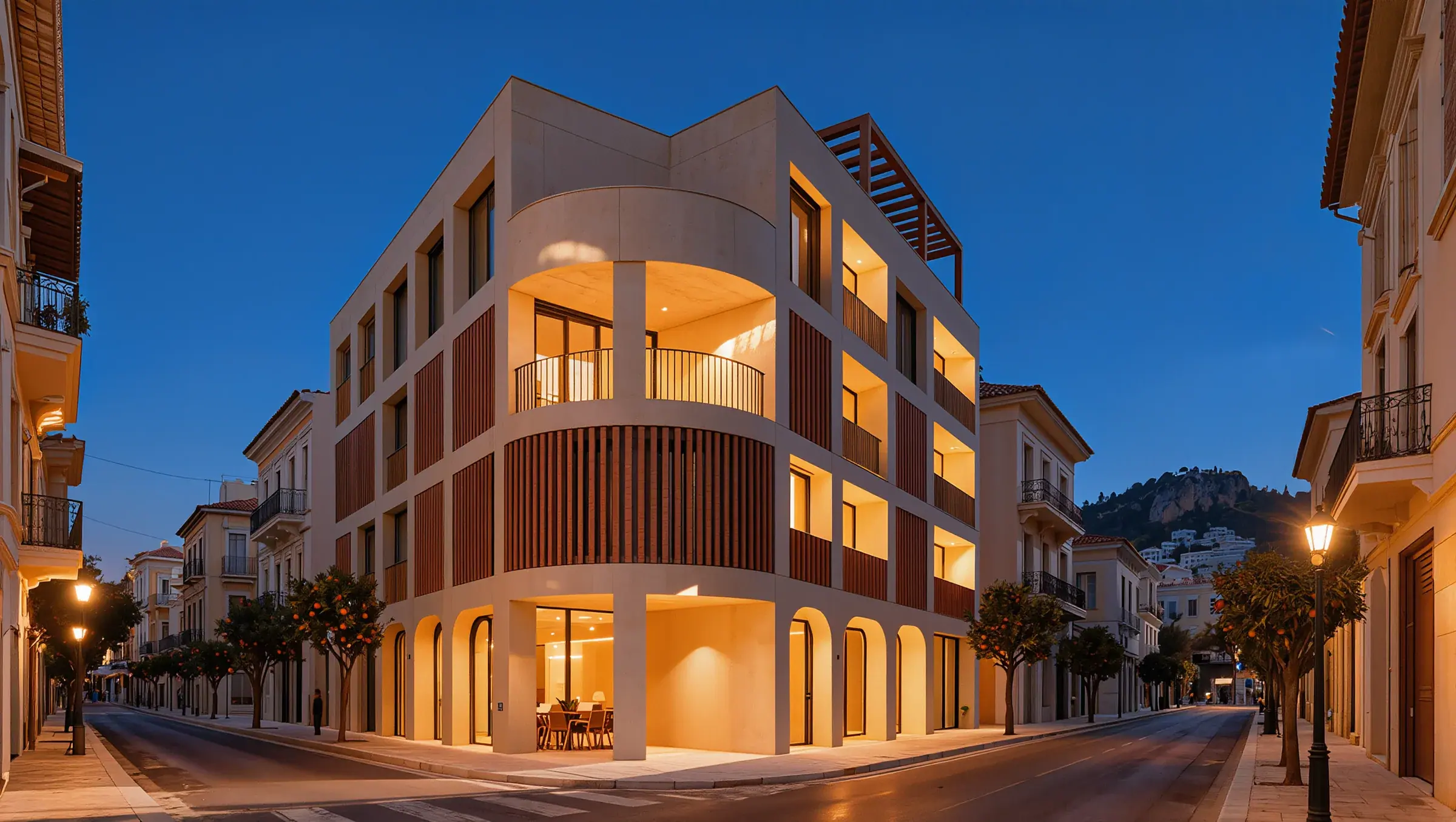
For many international buyers the clearer approach is to separate the two questions. A smaller new apartment, such as most of those in AKI GROUP's Ardittos Residences in Pangrati or Galini Seafront at Rio near Patras, can make sense as a home or a long-term rental investment in its own right, but it will not on its own provide a Golden Visa under the rules in force in October 2026. Anyone for whom residency is the main goal should start from the size and price thresholds, check the latest position with a Greek lawyer, and keep an eye on whether the proposed portfolio route becomes law.
This article is general information, not legal or tax advice.